Future of AI
In a nondescript building close to downtown Chicago, Marc Gyongyosi and the small but growing crew of IFM/Onetrack.AI have one rule that rules them all: think simple. The words are written in simple font on a simple sheet of paper that’s stuck to a rear upstairs wall of their industrial two-story workspace. What they’re doing here with artificial intelligence, however, isn’t simple at all. Sitting at his cluttered desk, located near an oft-used ping-pong table and prototypes of drones from his college days suspended overhead, Gyongyosi punches some keys on a laptop to pull up grainy video footage of a forklift driver operating his vehicle in a warehouse. It was captured from overhead courtesy of a Onetrack.AI “forklift vision system.”
Employing machine learning and computer vision for detection and classification of various “safety events,” the shoebox-sized device doesn’t see all, but it sees plenty. Like which way the driver is looking as he operates the vehicle, how fast he’s driving, where he’s driving, locations of the people around him and how other forklift operators are maneuvering their vehicles. IFM’s software automatically detects safety violations (for example, cell phone use) and notifies warehouse managers so they can take immediate action. The main goals are to prevent accidents and increase efficiency. The mere knowledge that one of IFM’s devices is watching, Gyongyosi claims, has had “a huge effect.”
“If you think about a camera, it really is the richest sensor available to us today at a very interesting price point,” he says. “Because of smartphones, camera and image sensors have become incredibly inexpensive, yet we capture a lot of information. From an image, we might be able to infer 25 signals today, but six months from now we’ll be able to infer 100 or 150 signals from that same image. The only difference is the software that’s looking at the image. And that’s why this is so compelling, because we can offer a very important core feature set today, but then over time all our systems are learning from each other. Every customer is able to benefit from every other customer that we bring on board because our systems start to see and learn more processes and detect more things that are important and relevant.”
THE EVOLUTION OF AI
IFM is just one of countless AI innovators in a field that’s hotter than ever and getting more so all the time. Here’s a good indicator: Of the 9,100 patents received by IBM inventors in 2018, 1,600 (or nearly 18 percent) were AI-related. Here’s another: Tesla founder and tech titan Elon Musk recently donated $10 million to fund ongoing research at the non-profit research company OpenAI — a mere drop in the proverbial bucket if his $1 billion co-pledge in 2015 is any indication. And in 2017, Russian president Vladimir Putin told school children that “Whoever becomes the leader in this sphere [AI] will become the ruler of the world.” He then tossed his head back and laughed maniacally.
OK, that last thing is false. This, however, is not: After more than seven decades marked by hoopla and sporadic dormancy during a multi-wave evolutionary period that began with so-called “knowledge engineering,” progressed to model- and algorithm-based machine learning and is increasingly focused on perception, reasoning and generalization, AI has re-taken center stage as never before. And it won’t cede the spotlight anytime soon.
THE FUTURE IS NOW: AI'S IMPACT IS EVERYWHERE
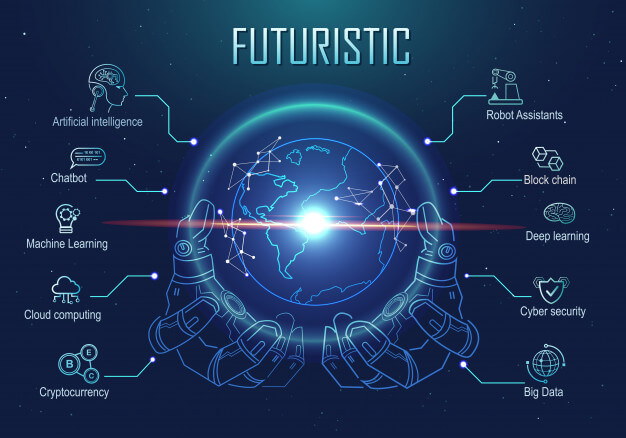
There’s virtually no major industry modern AI — more specifically, “narrow AI,” which performs objective functions using data-trained models and often falls into the categories of deep learning or machine learning — hasn’t already affected. That’s especially true in the past few years, as data collection and analysis has ramped up considerably thanks to robust IoT connectivity, the proliferation of connected devices and ever-speedier computer processing.
With companies spending nearly $20 billion collective dollars on AI products and services annually, tech giants like Google, Apple, Microsoft and Amazon spending billions to create those products and services, universities making AI a more prominent part of their respective curricula (MIT alone is dropping $1 billion on a new college devoted solely to computing, with an AI focus), and the U.S. Department of Defense upping its AI game, big things are bound to happen. Some of those developments are well on their way to being fully realized; some are merely theoretical and might remain so. All are disruptive, for better and potentially worse, and there’s no downturn in sight.
AI AND THE FUTURE OF PRIVACY & HUMAN RIGHTS
Of course, much has been made of the fact that AI’s reliance on big data is already impacting privacy in a major way. Look no further than Cambridge Analytica’s Facebook shenanigans or Amazon’s Alexa eavesdropping, two among many examples of tech gone wild. Without proper regulations and self-imposed limitations, critics argue, the situation will get even worse. In 2015, Apple CEO Tim Cook derided competitors Google and Facebook (surprise!) for greed-driven data mining.
“However, as is the case with most emerging technology, there is a real risk that commercial and state use has a detrimental impact on human rights. In particular, applications of these technologies frequently rely on the generation, collection, processing, and sharing of large amounts of data, both about individual and collective behavior. This data can be used to profile individuals and predict future behavior. While some of these uses, like spam filters or suggested items for online shopping, may seem benign, others can have more serious repercussions and may even pose unprecedented threats to the right to privacy and the right to freedom of expression and information (‘freedom of expression’). The use of AI can also impact the exercise of a number of other rights, including the right to an effective remedy, the right to a fair trial, and the right to freedom from discrimination.”